
A grandparent does not need to speak your family language fluently to become part of your child's bilingual world.
Sometimes a few familiar words, a willingness to sound slightly ridiculous and a toddler prepared to correct everyone are enough to begin.
In our household, most of Zina's Russian comes from Pappa, but it does not come from Pappa alone. Mumma has completed four years of Russian classes and regularly speaks Russian with Zina too, although Zina still corrects her from time to time. Apparently, four years of study does not outrank the confidence of a three-year-old native speaker.
A little language inside ordinary life
Zina also hears and uses Russian at church and when visiting Pappa's side of the family. Each relationship gives her another place where Russian feels natural and useful.
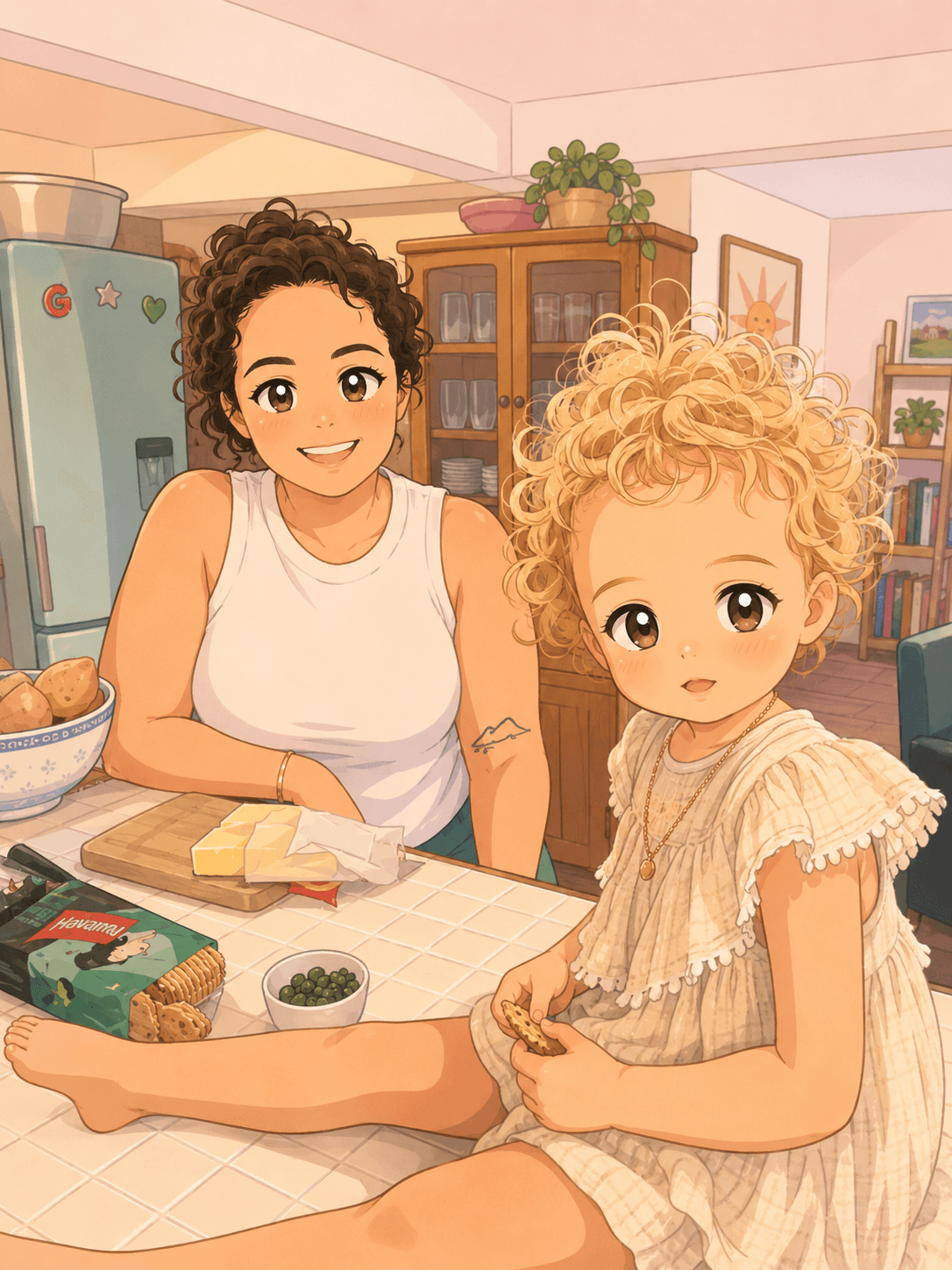
Her grandmother Julie, who calls herself Gigi, has taken an interest in learning words and short phrases she can use with Zina during their ordinary time together. Gigi does not speak Russian, but she uses what she knows while helping Zina get dressed for daycare, preparing a snack or simply spending time with her.
These are not lengthy philosophical discussions in Russian. They are small exchanges woven into ordinary life, and that is precisely why they matter.
Most of a young child's language is built from hundreds of small, repeated interactions: finding shoes, choosing food, getting dressed, going outside and celebrating a job well done. When a grandparent learns even a few expressions for these moments, the family language begins appearing in another relationship and another part of the child's day.
For Zina, Pappa remains her main source of Russian, but the language is reinforced by Mumma, Gigi, church and family. Sometimes it appears during a conversation with relatives. Sometimes it appears while Gigi is searching for a missing sock or negotiating the distribution of snacks, two very important areas of toddler diplomacy.
The amount of Russian used in each relationship is different, but the message underneath it is the same: this language belongs here too.
Children notice when someone makes the effort
Zina likes hearing Gigi use Russian. Sometimes she responds directly to one of Gigi's familiar cues. At other times, she adds a Russian statement of her own.
This can leave Gigi with a new problem: she has successfully started a Russian conversation but does not necessarily know which conversation she has started. This is both a language-learning success and a slight failure of forward planning.
She might ask me later, 'What does this mean?' Sometimes she looks it up herself. At other times, the exchange becomes a wonderfully mixed conversation in which Gigi uses the Russian she knows, Zina contributes whatever she feels the situation requires and both somehow continue.
It is not perfect Russian immersion. It is something more realistic: two people finding a way to meet each other across a language barrier.
That effort matters to a child. Zina can see that Gigi considers her Russian important enough to learn, even if it is only one phrase at a time.
Grandparents do not need to become language teachers
It can be tempting to think that a caregiver must speak a language fluently before using it with a child. Otherwise, perhaps they will make mistakes, pronounce something incorrectly or confuse the child.
But a grandparent does not need to become a second language teacher. Their more valuable role is to become another person with whom the language feels welcome.
A handful of useful phrases spoken warmly and repeatedly can do more than a long vocabulary list that nobody remembers to use. The phrases become attached to routines, people and feelings.
A word for socks belongs to mornings with Gigi. A phrase about food belongs to sitting together with a snack. A familiar expression from a story belongs to curling up beside someone who loves you.
That emotional setting gives language meaning.
Begin with phrases they will actually use
Do not hand Grandma or Grandpa a list of 150 carefully categorised vocabulary words unless you would like that list to be placed somewhere safe and never seen again.
Start with five or ten expressions connected to things they already do with your child. Short phrases are often more useful than isolated nouns. Knowing the word for 'sock' is helpful. Knowing how to say 'Where are your socks?' creates an interaction.
You can record the phrases on their phone so they can hear the pronunciation. Keep the list somewhere easy to find and add new expressions gradually. The goal is not to test the grandparent. It is to give them a small collection of words that will naturally become part of their time with the child.
- Getting dressed
- Mealtimes and snacks
- Bath time
- Going outside
- Encouragement and affection
- Favourite toys
- Bedtime
- Reading together
Let the child become the expert sometimes
One of the loveliest changes happens when the child realises that they know something the adult does not.
If Zina says something Gigi does not understand, that is not necessarily a failed conversation. It can become an invitation. Gigi can ask her to show her, repeat it or help her understand. She can remember the sound and ask Pappa later. She can look it up and try again next time.
This changes the child's role. Instead of always being the person receiving language, the child gets to contribute knowledge. They discover that their family language is not limited to one parent or one part of life. It can belong at home with Mumma and Pappa, in little exchanges with Gigi, at church and in conversations with extended family.
There is also something naturally funny about a toddler becoming the household's language consultant. The consultant may be knowledgeable, but her availability, patience and fee structure remain unpredictable.
Stories offer grandparents a gentle way in
Books are especially useful because the pictures, sequence and familiar storyline provide clues. A grandparent may not understand every word of the family language, but they can still point, repeat a phrase, ask a simple question or recognise what is happening.
A familiar book makes this easier. The grandparent already knows the story, and the child often knows it even better. Neither person must understand every sentence for the reading experience to work.
This was part of the thinking behind LinguaLayers: helping families add another language to books their children already know and love. A translated layer can give a grandparent enough support to read a line, practise a phrase or share part of the story without needing to speak the language fluently.
The objective is not a flawless performance. It is shared attention: grandparent, child, pictures, words and perhaps some creative pronunciation along the way.
Keep it warm, not corrective
If a grandparent mispronounces something, correct gently, or sometimes let it pass. Toddlers are generally generous about accents, although their corrections may not always be delivered with diplomatic restraint.
Young children cope remarkably well with different voices and accents. What matters most is that the interaction remains enjoyable. Constant correction can make an enthusiastic grandparent nervous and turn a warm exchange into an oral examination.
The same applies to the child. If they answer in English, mix languages or say something the grandparent cannot follow, the conversation has not failed. They are communicating.
Language grows most comfortably when people want to keep talking to one another.
The deeper gift
When grandparents learn part of a child's family language, they are doing more than helping with vocabulary.
They are showing respect for the people, memories and culture carried by that language. They are helping the child feel that the different parts of their family do not have to remain in separate compartments.
Gigi may never have long conversations with Zina entirely in Russian. That is not the measure of success.
Success can be Zina hearing a familiar Russian phrase while getting ready for daycare, smiling because it came from Gigi and answering with a few words of her own. It can be Gigi looking up what Zina said because she genuinely wants to understand. It can be a mixed-language conversation held together by affection, gestures, repetition and the shared understanding that snacks are now being requested.
A few words cannot remove every language barrier. But spoken with love, they can open a small door through it.